1-month Case study, Royal College of Art, 2024
5-month Academic project, Royal College of Art, 2025

ZOE Science: Grocery Personalised Nutrition Choice
ZOE Science: Grocery Personalised Nutrition Choice
ZOE Science: Grocery Personalised Nutrition Choice
Designing 2 business strategies to solve the low user retention issue, while increasing the frequency of ZOE's presence in everyday food decisions.
Designing 2 business strategies to solve the low user retention issue, while increasing the frequency of ZOE's presence in everyday food decisions.
Industry
Industry
Industry
Healthcare; Business
Healthcare; Business
Healthcare; Business
My Role
My Role
My Role
UX Researcher & Designer
UX Researcher & Designer
UX Researcher & Designer
Design at
Design at
Design at
Royal College of Art
Royal College of Art
Royal College of Art
The Overview
The Overview
The Overview
This commissioned research project was developed as part of the MA Service Design programme at the Royal College of Art, to address a core retention challenge.
Although ZOE is a credible science platform and personalised food scoring engine, 50% of users churn within six to nine months. Through user research, the project identified one of the significant barriers happened during the user experience: ZOE intervenes after decisions are already made, such as meals cooked, products bought. The knowledge or advice arrives too late to change behaviour.
This commissioned research project was developed as part of the MA Service Design programme at the Royal College of Art, to address a core retention challenge.
Although ZOE is a credible science platform and personalised food scoring engine, 50% of users churn within six to nine months. Through user research, the project identified one of the significant barriers happened during the user experience: ZOE intervenes after decisions are already made, such as meals cooked, products bought. The knowledge or advice arrives too late to change behaviour.
This commissioned research project was developed as part of the MA Service Design programme at the Royal College of Art, to address a core retention challenge.
Although ZOE is a credible science platform and personalised food scoring engine, 50% of users churn within six to nine months. Through user research, the project identified one of the significant barriers happened during the user experience: ZOE intervenes after decisions are already made, such as meals cooked, products bought. The knowledge or advice arrives too late to change behaviour.
The Results
The Results
The Results
In March 2025, 5 months after this project concluded, ZOE launched an AI food scanner to open its American market, securing $15M in Series B+ funding, which independently validated the strategic direction this project identified.
In March 2025, 5 months after this project concluded, ZOE launched an AI food scanner to open its American market, securing $15M in Series B+ funding, which independently validated the strategic direction this project identified.
In March 2025, 5 months after this project concluded, ZOE launched an AI food scanner to open its American market, securing $15M in Series B+ funding, which independently validated the strategic direction this project identified.
How Might We?
How Might We?
bring ZOE's personalised nutrition knowledge into the moment of everyday food decisions, empowering people to make healthier choices with confidence?
bring ZOE's personalised nutrition knowledge into the moment of everyday food decisions, empowering people to make healthier choices with confidence?
Where DID this began? What did i found?
Where DID this began? What did i found?
BACKGROUND & PROBLEM
BACKGROUND & PROBLEM
BACKGROUND & PROBLEM
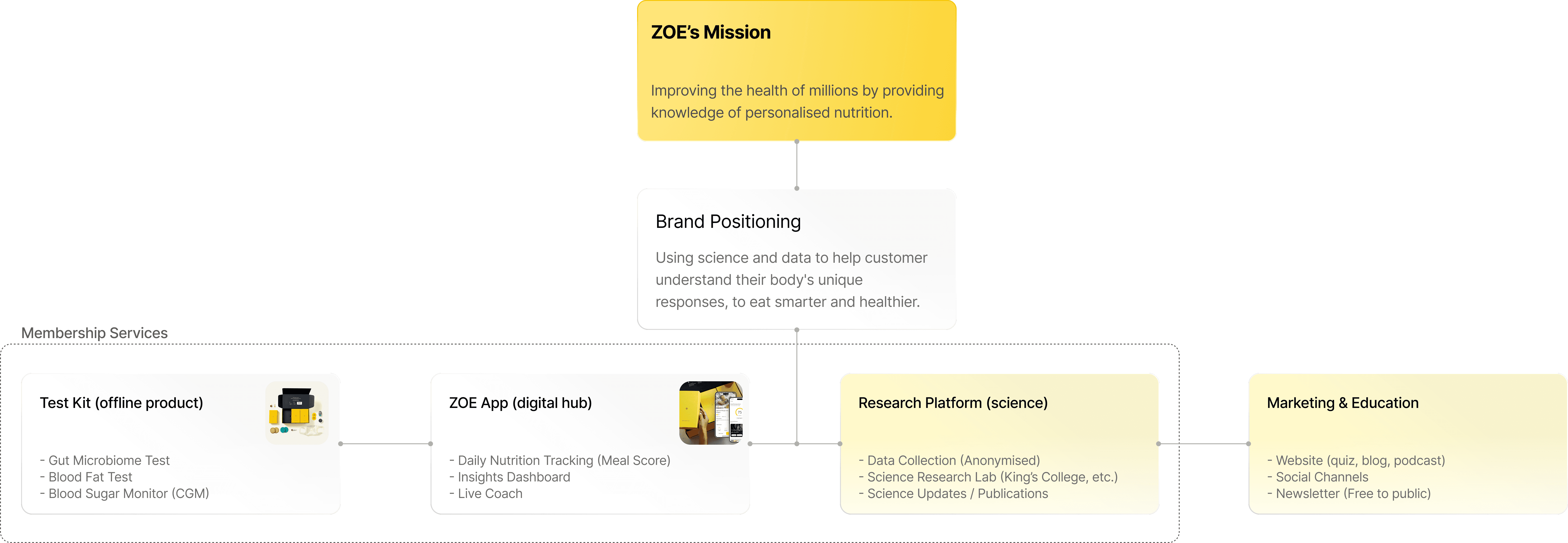
Understand ZOE and their frictions
What sets ZOE apart is their scientific foundation, which has revealed eye-opening findings about the significant variations in individuals' responses to the same meal.
With their flagship product, the ZOE plan, they offer a test kit that analyses your unique biological response to food. Through advanced scientific insights, ZOE uncovers valuable information about your body and creates personalised eating plans tailored specifically to your gut microbes and inflammation after meals.
Instead of a "one-size-fits-all" approach to dieting, ZOE champions the belief that an individual’s unique biology determines how they should eat for optimal health. However, the data suggests that Zoe is struggling to fulfil its mission of ‘improving the health of millions by providing knowledge of personalised nutrition’. This formed the starting point and design direction for this project.
Pain point
User Retention
Personalised nutrition products struggle to build lasting habits. ZOE lost 23% of its user base in a single year. Half of all subscribers discontinue within six to nine months.
50% churn within 6–9 months
130k (2023)→ 100k (2024) users in one year
50% churn within 6–9 months
130k (2023)→ 100k (2024) users in one year
BUT …
BUT …
Opportunity 01
Business Opportunity
Research showed users managing chronic conditions(Type 2 diabetes, high cholesterol, menopause,etc)gained the most from personalised nutrition. Yet no product in the space is purpose-built for preventative clinical use.
Opportunity 02
Systemic Innovation
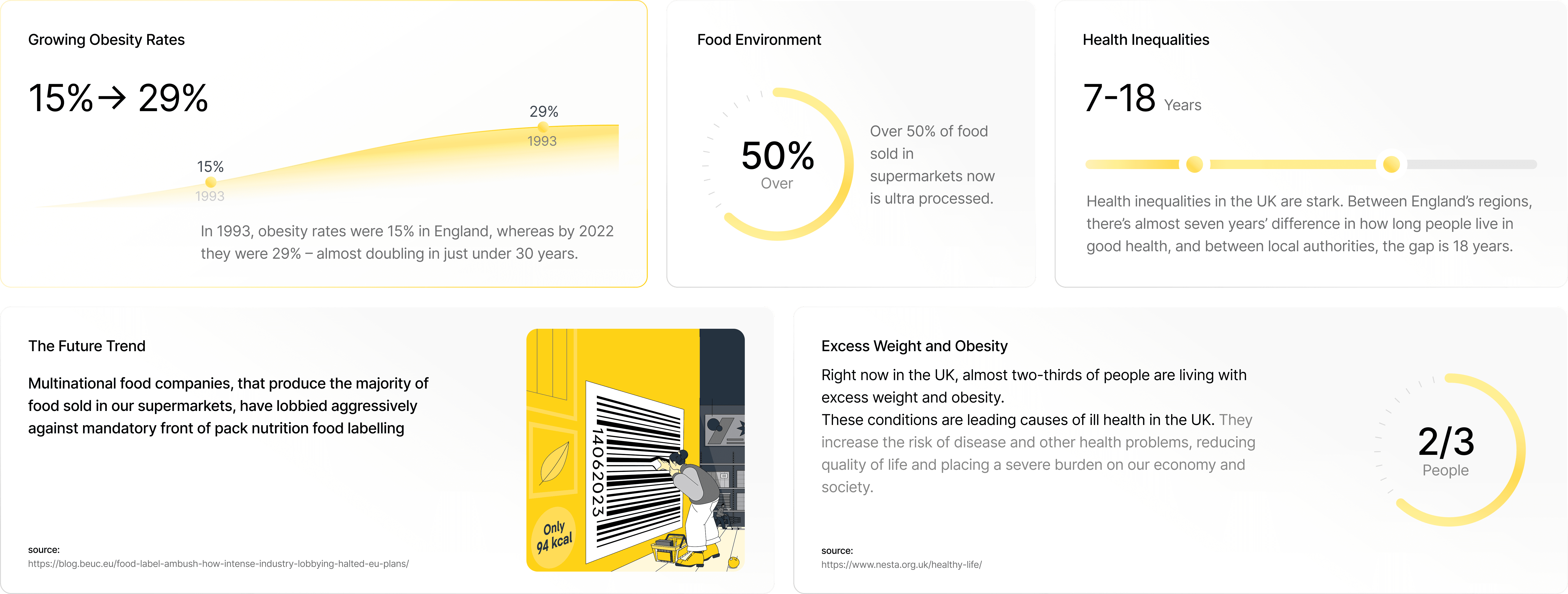
Over 50% of supermarket food is ultra-processed. Decades of industry-funded research have trained people to judge food by calories alone , making genuinely good choices harder than it should be.
What did i create?
What did i create?
DESIGN DELIVER
DESIGN DELIVER
DESIGN DELIVER
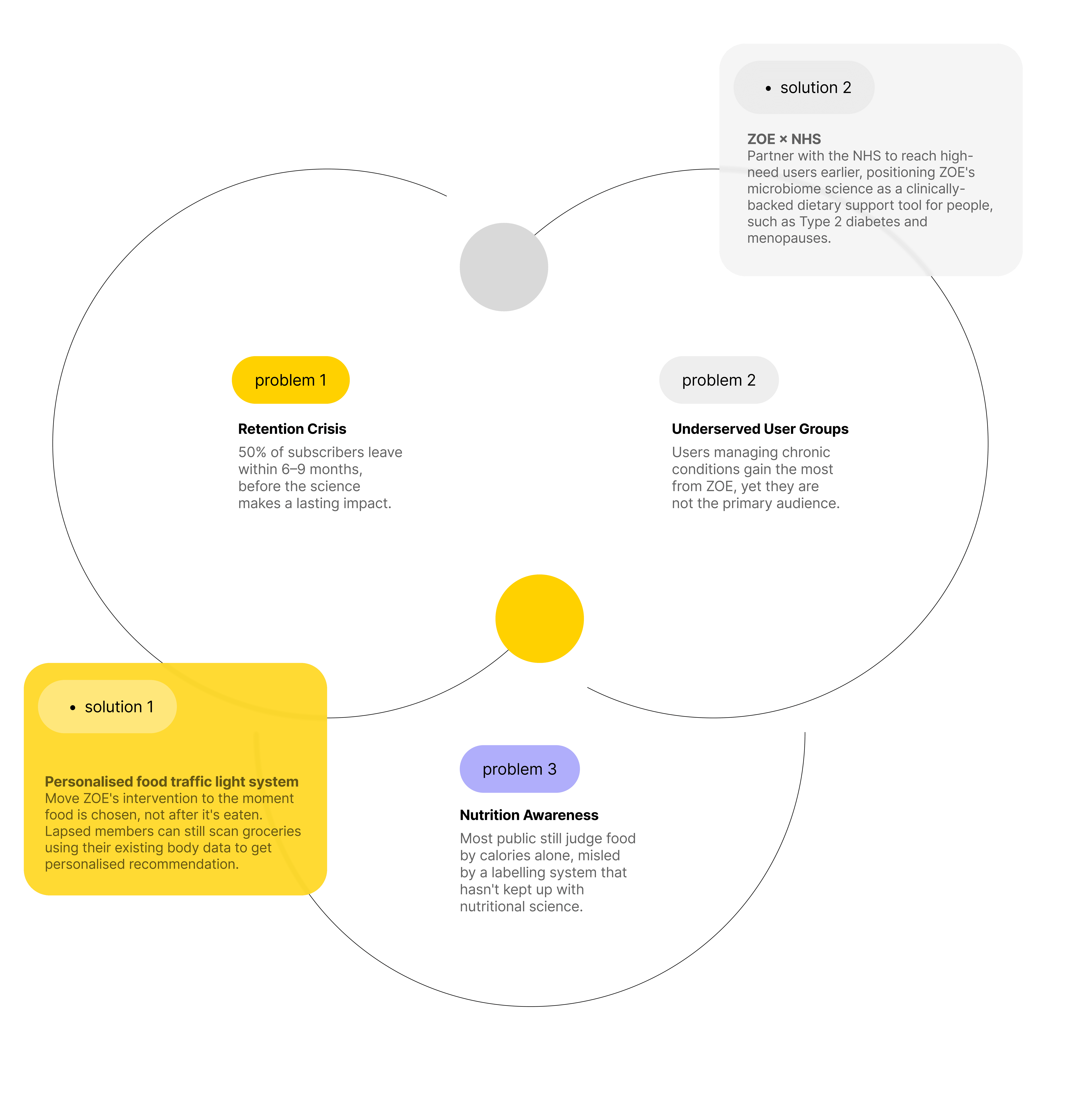
Renew the ZOE app service touchpoint
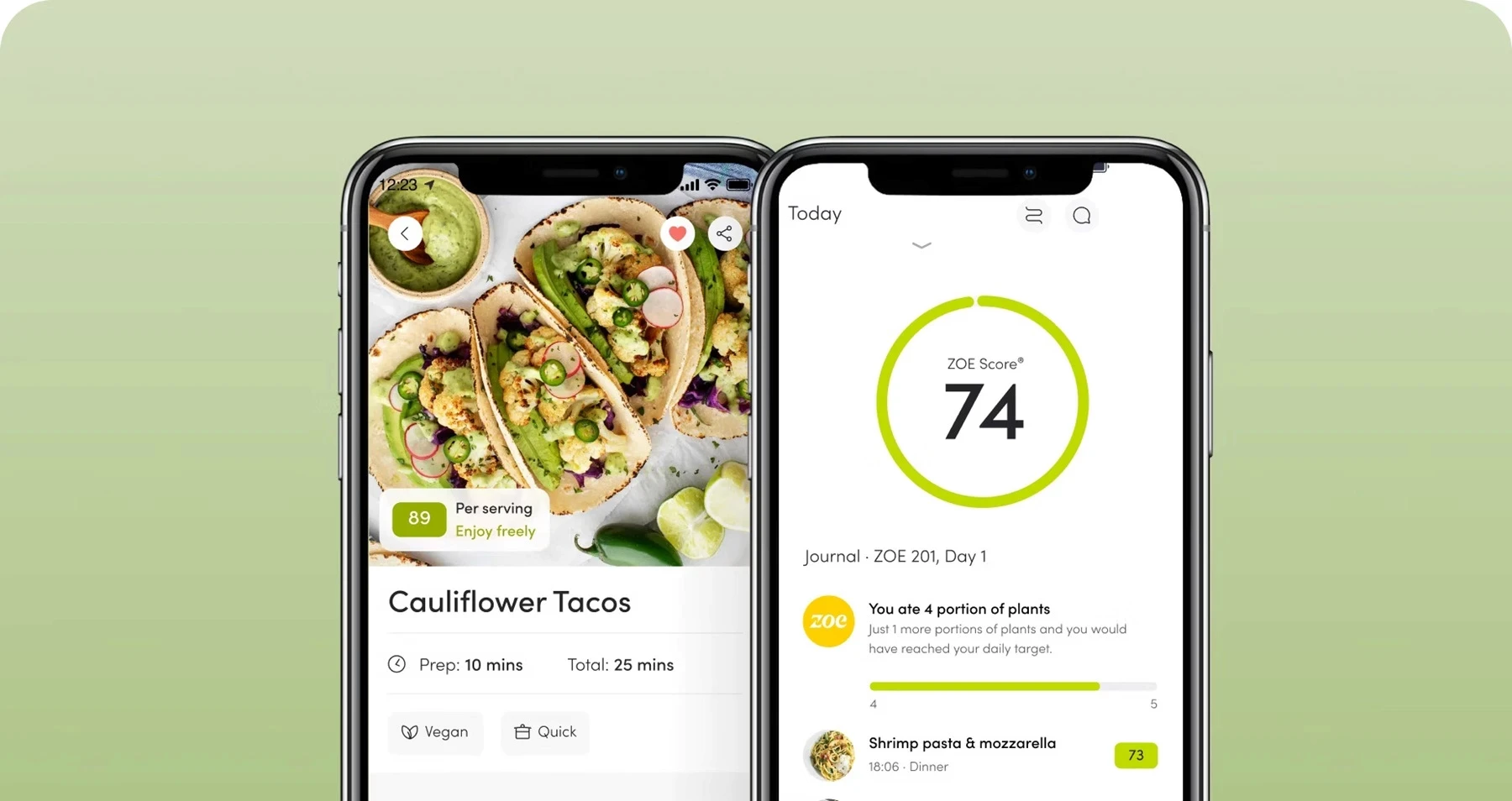
Based on the research that ZOE's food scoring engine isn't the problem, the user journey is the main barrier cause the main user group to quit after 5-6 months. Research identified one critical moment where engagement consistently breaks down: meal logging step. By the time a user opens the app to score what they've eaten, the decision has already been made. The friction of the upload process, the wrong ingredients, the sunk cost of cooking a low-scoring meal with no way to course-correct, these aren't usability failures.
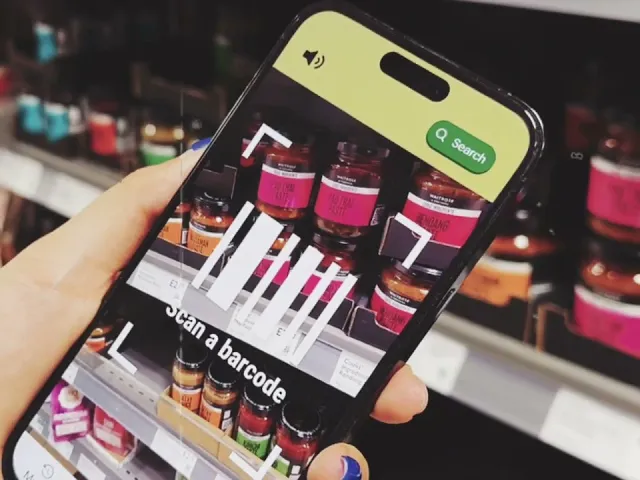
The strategic response wasn't to rebuild. It was to reposition the key touchpoint of the product. So the new strategy moves ZOE's intervention much earlier to the meal preparation stage, which means when people are shopping for groceries, ZOE could help them make nutritional choices based on trusted personalised advice.
Based on the research that ZOE's food scoring engine isn't the problem, the user journey is the main barrier cause the main user group to quit after 5-6 months. Research identified one critical moment where engagement consistently breaks down: meal logging step. By the time a user opens the app to score what they've eaten, the decision has already been made. The friction of the upload process, the wrong ingredients, the sunk cost of cooking a low-scoring meal with no way to course-correct, these aren't usability failures.
The strategic response wasn't to rebuild. It was to reposition the key touchpoint of the product. So the new strategy moves ZOE's intervention much earlier to the meal preparation stage, which means when people are shopping for groceries, ZOE could help them make nutritional choices based on trusted personalised advice.
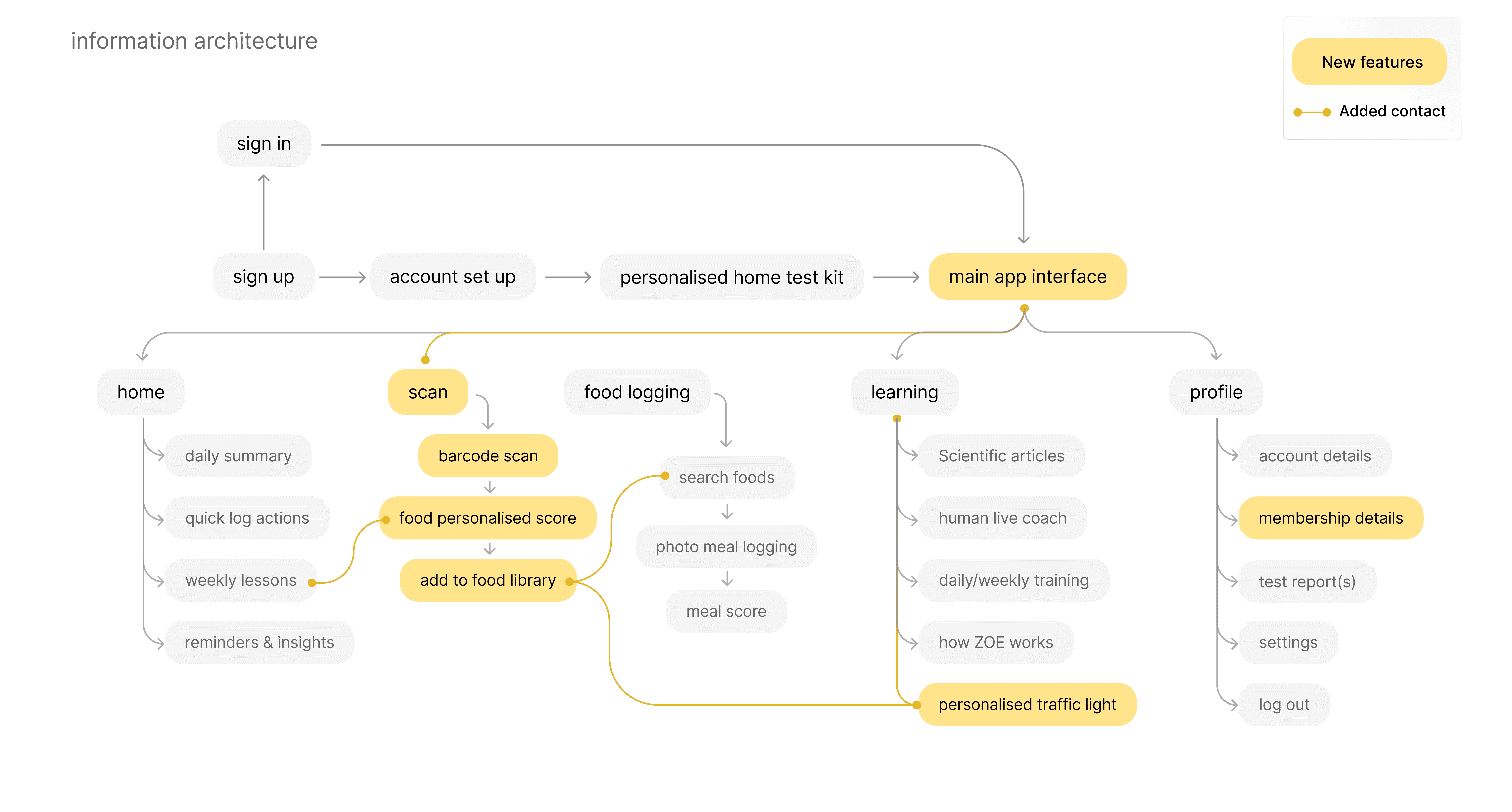
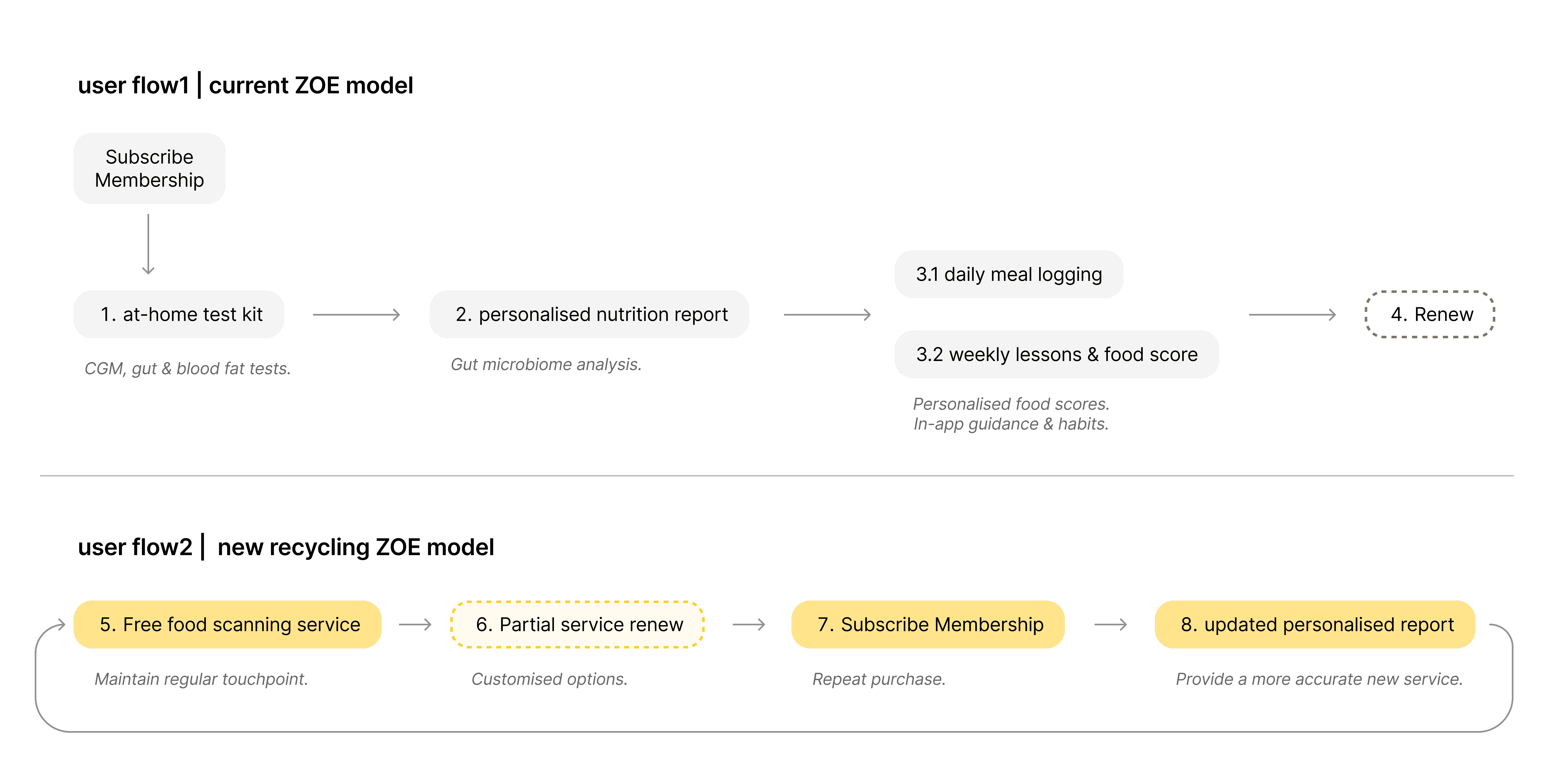
From a brand strategy perspective, the new service model introduces a single addition to the existing design system and restructures what happens after membership ends, shifting ZOE from a one-time service into a continuous presence at the point of decision.
The result addresses two problems simultaneously: reducing user churn through sustained post-membership engagement, and extending ZOE's personalised nutrition science to a broader public, reaching people at the supermarket shelf who would never have encountered it otherwise.
From a brand strategy perspective, the new service model introduces a single addition to the existing design system and restructures what happens after membership ends, shifting ZOE from a one-time service into a continuous presence at the point of decision.
The result addresses two problems simultaneously: reducing user churn through sustained post-membership engagement, and extending ZOE's personalised nutrition science to a broader public, reaching people at the supermarket shelf who would never have encountered it otherwise.
What did I build? What did I learn?
What did I build? What did I learn?
PROCESS & CHALLENGES
PROCESS & CHALLENGES
PROCESS & CHALLENGES
Q1: What is the user group? Why do — or don't — customers choose ZOE?
Q1: What is the user group? Why do — or don't — customers choose ZOE?
Q1: What is the user group? Why do — or don't — customers choose ZOE?
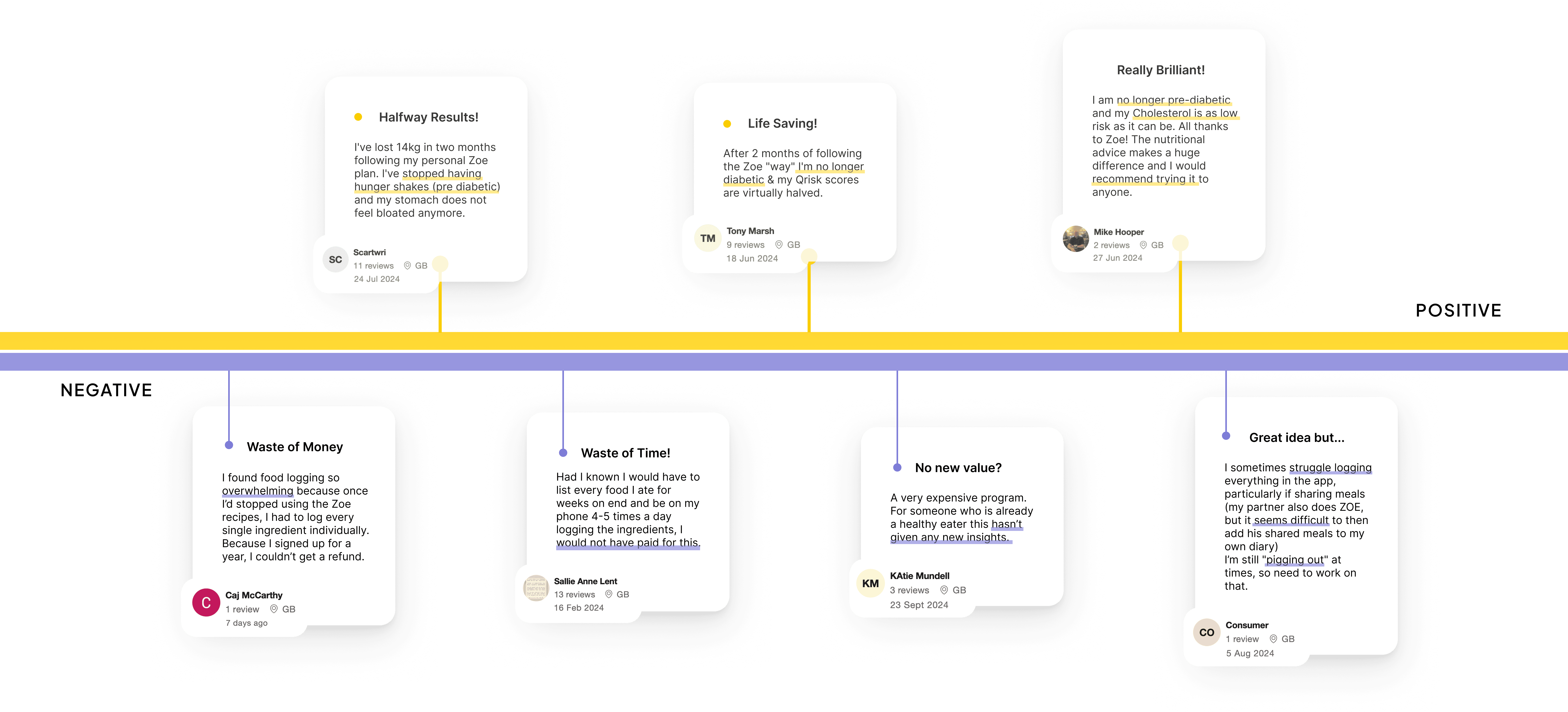
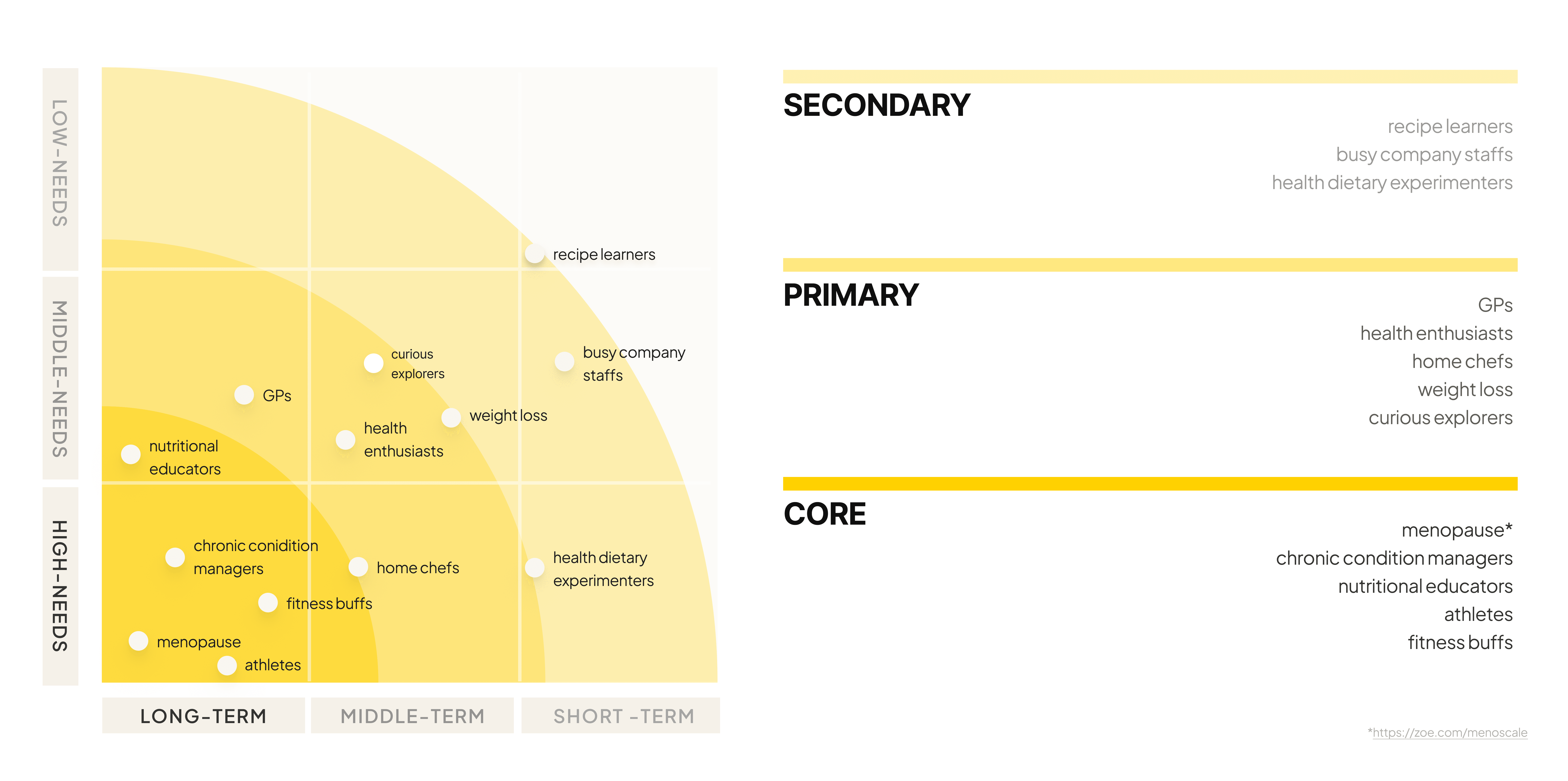
Users managing their long-term health conditions, engaged deeply and consistently. For them, every data point mattered because the stakes were ongoing. ZOE didn't just teach them something; it became part of how they managed their lives.
But the majority of ZOE's acquired users sat in a different quadrant entirely: curious explorers, busy professionals, health experimenters. Drawn in by the brand's science communication, their engagement was always going to be bounded. Once the learning curve flattened, the app had nothing new to offer them.
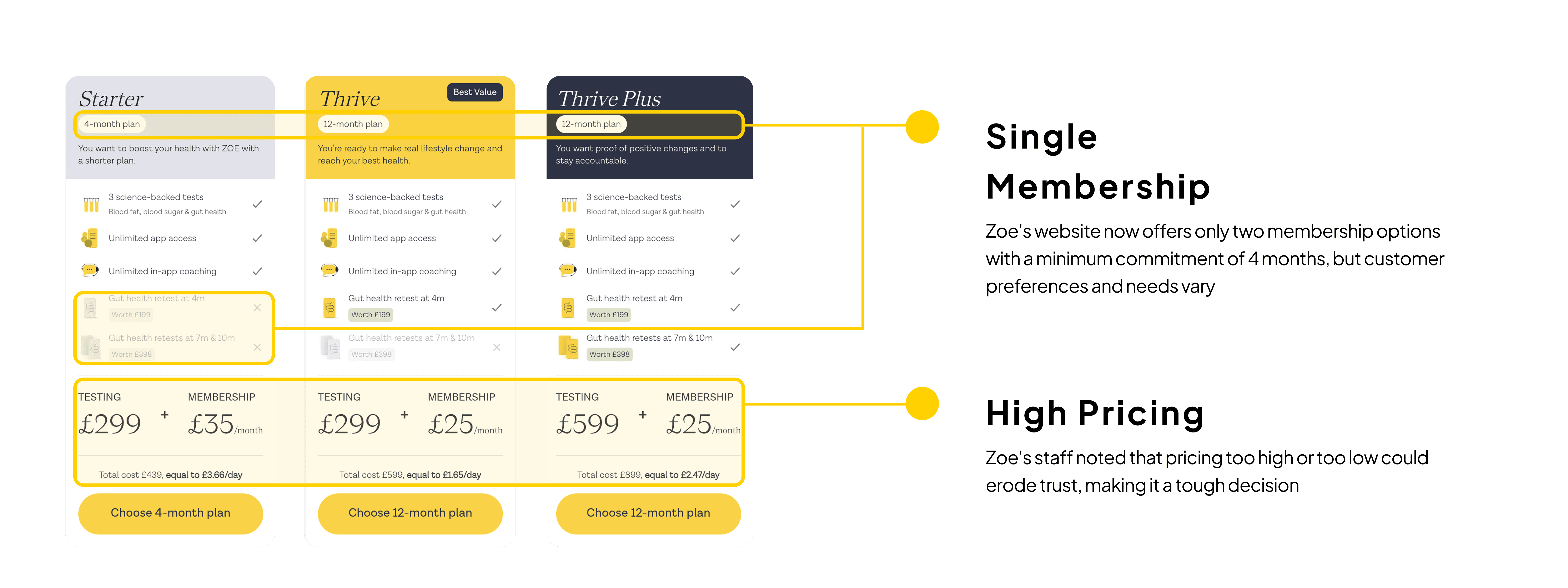
On the other hand, ZOE currently offers only two membership options, both with a minimum four-month commitment.
For the long-term user, four months is nothing — they'd renew indefinitely. For the curious user, four months is already stretching it.
Users managing their long-term health conditions, engaged deeply and consistently. For them, every data point mattered because the stakes were ongoing. ZOE didn't just teach them something; it became part of how they managed their lives.
But the majority of ZOE's acquired users sat in a different quadrant entirely: curious explorers, busy professionals, health experimenters. Drawn in by the brand's science communication, their engagement was always going to be bounded. Once the learning curve flattened, the app had nothing new to offer them.
On the other hand, ZOE currently offers only two membership options, both with a minimum four-month commitment.
For the long-term user, four months is nothing — they'd renew indefinitely. For the curious user, four months is already stretching it.
This answers the question at the beginning:
The £160 renewal doesn't compete with the feeling of having already learned enough.
However, the issue of pricing is merely a symptom; the real problem lies in the mismatch between demand and value.
This answers the question at the beginning:
The £160 renewal doesn't compete with the feeling of having already learned enough.
However, the issue of pricing is merely a symptom; the real problem lies in the mismatch between demand and value.
Q2: What do those users really need? How to keep their curious users while building healthy habits?
The daily meal logging step is the core habit ZOE is built around, which was consistently where engagement broke down. Users described it as effortful in a way that felt disproportionate: by the time you've cooked and eaten, opening the app to upload and score a meal you can no longer change feels like paperwork, not insight. The feedback arrives too late to influence the decision it's supposedly informing.
This wasn't a usability failure. It was a timing failure.
The daily meal logging step is the core habit ZOE is built around, which was consistently where engagement broke down. Users described it as effortful in a way that felt disproportionate: by the time you've cooked and eaten, opening the app to upload and score a meal you can no longer change feels like paperwork, not insight. The feedback arrives too late to influence the decision it's supposedly informing.
This wasn't a usability failure. It was a timing failure.
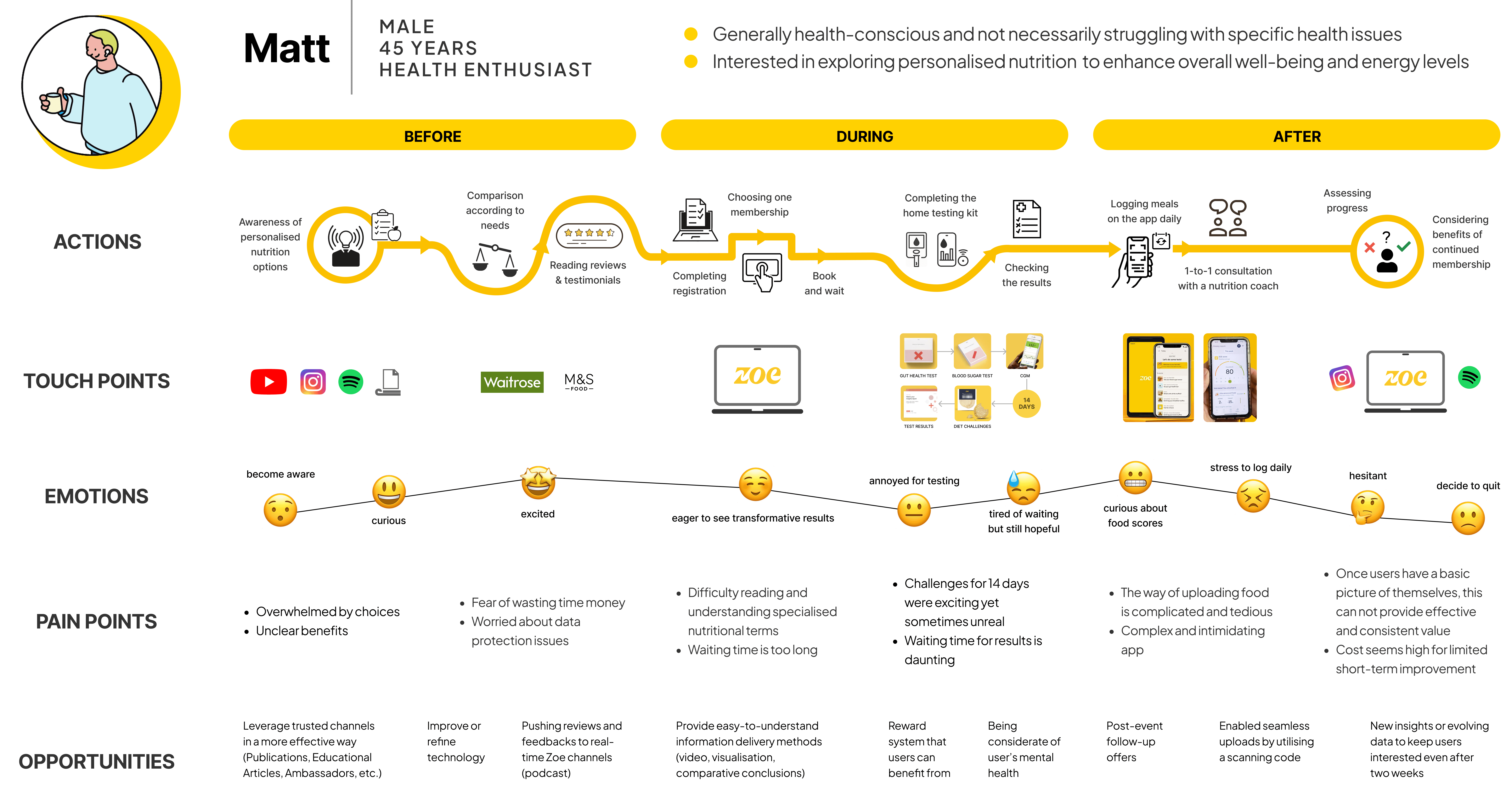
Like a lot of comments we found on the internet, Matt, one of our interviewees, who left ZOE after 4 months, is a big fan of personalised nutrition. “I like the idea,” he said, “but honestly, I don’t have time to log everything I eat.”
Also, even when he rated a meal poorly, he’d still eat it, simply because it was already bought or made. “I understand the food I bought was unhealthy for me, but I still have it, since I've owned it. What should I do?”
Like a lot of comments we found on the internet, Matt, one of our interviewees, who left ZOE after 4 months, is a big fan of personalised nutrition. “I like the idea,” he said, “but honestly, I don’t have time to log everything I eat.”
Also, even when he rated a meal poorly, he’d still eat it, simply because it was already bought or made. “I understand the food I bought was unhealthy for me, but I still have it, since I've owned it. What should I do?”
If even committed ZOE users struggled to build the habit around logging, what did that mean for people who had never experienced the product's core value at all?
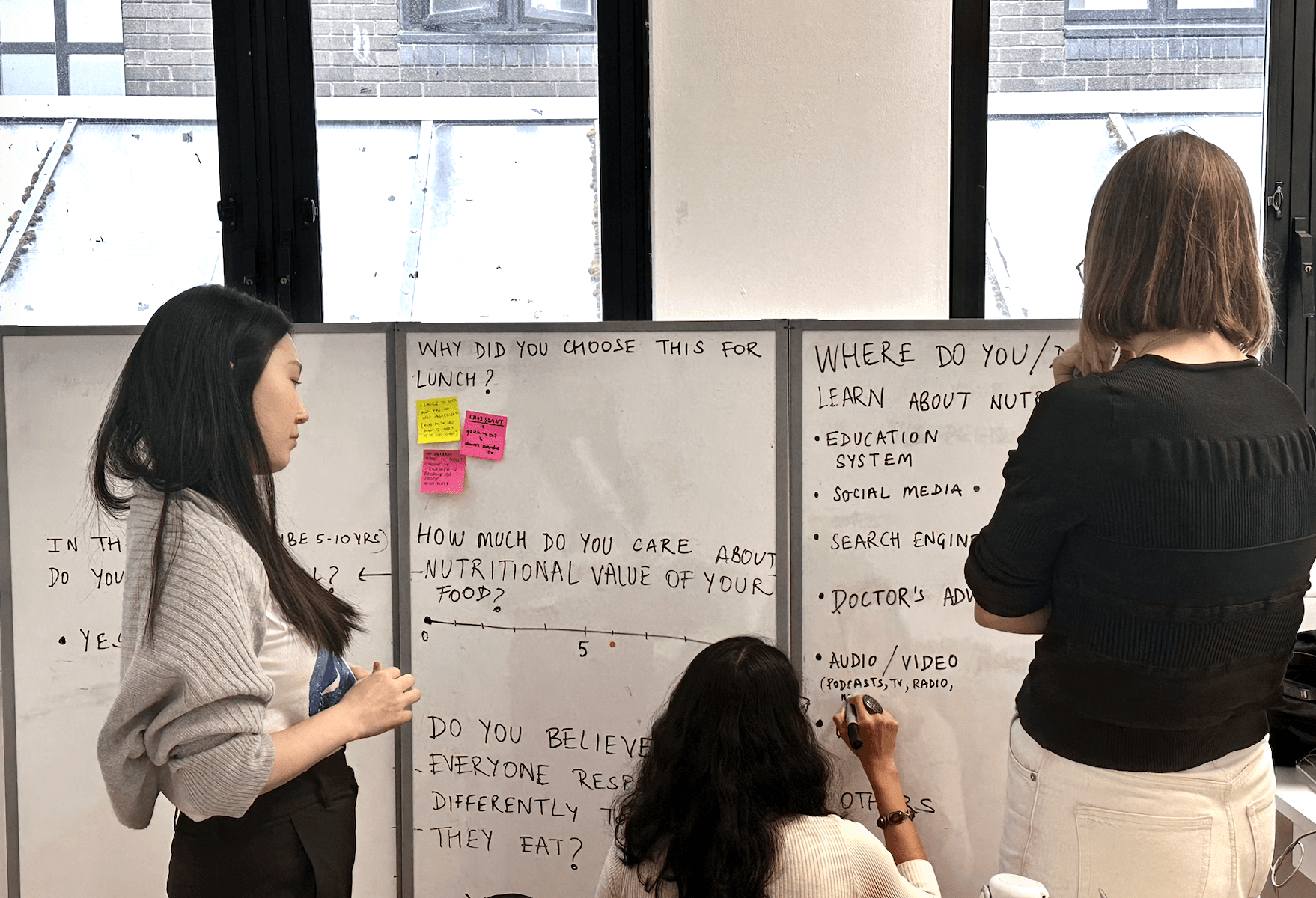
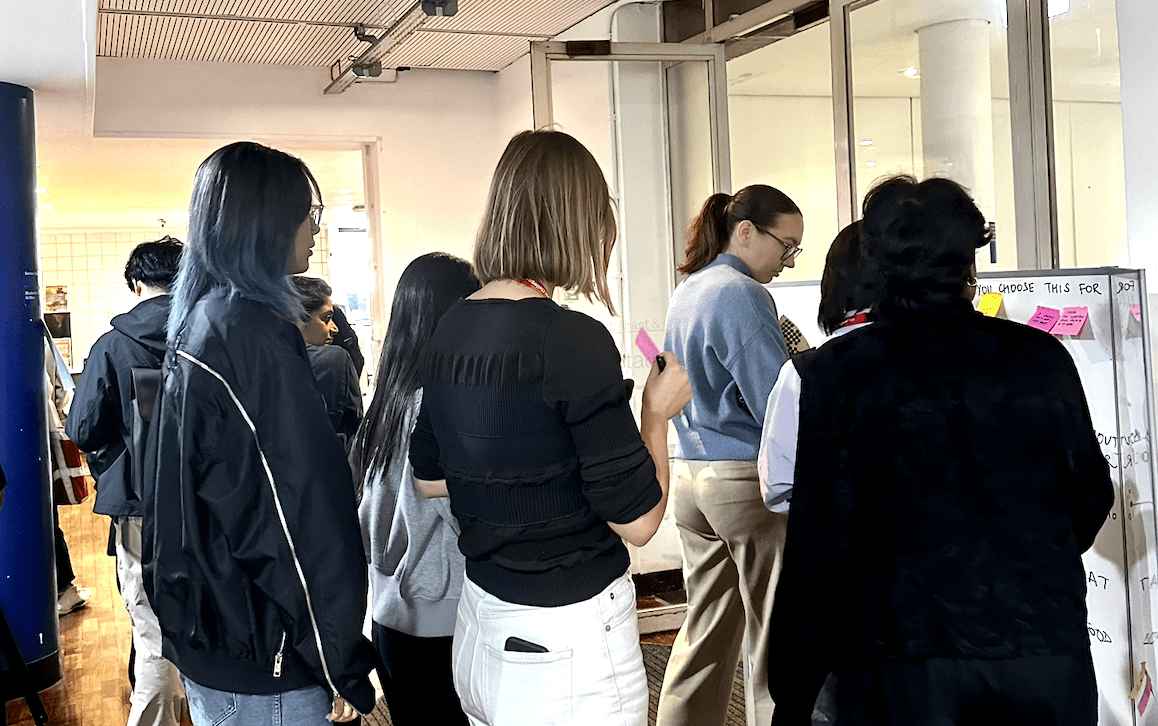
We took our questions into the streets, from campus canteens, to supermarket entrances, then public spaces, with a white board full of questions and an open mind for the conversations.
The data and insights showed:
Food choice: people judged food primarily by calories, made eating decisions situationally rather than intentionally
Personalised nutrition: people had low awareness that their body might respond differently to the same food than someone else's. But over 82% of them think personalised nutrition is useful and the future trend, 87% of them said they want to try it one day.
If even committed ZOE users struggled to build the habit around logging, what did that mean for people who had never experienced the product's core value at all?
We took our questions into the streets, from campus canteens, to supermarket entrances, then public spaces, with a white board full of questions and an open mind for the conversations.
The data and insights showed:
Food choice: people judged food primarily by calories, made eating decisions situationally rather than intentionally
Personalised nutrition: people had low awareness that their body might respond differently to the same food than someone else's. But over 82% of them think personalised nutrition is useful and the future trend, 87% of them said they want to try it one day.
ZOE's most valuable intervention is personalised food guidance; however, it consistently arrives after the moment of choice, not before it.
ZOE's most valuable intervention is personalised food guidance; however, it consistently arrives after the moment of choice, not before it.
What did I get?
What did I get?
EVALUATION
EVALUATION
EVALUATION
Market and Food Environment Opportunity
Market and Food Environment Opportunity
Market and Food Environment Opportunity
Peanut Butter Experiment
Peanut Butter Experiment
Peanut Butter Experiment
Let me introduce you to the interesting experiment we did. We called it "peanut butter experiment".
We took the same everyday product, peanut butter, and asked two systems to evaluate it.
The NHS app advised avoiding it, suggesting a swap for an artificially sweetened, near-zero-nutritional-value syrup. The logic was calorie reduction: fat is bad, fewer calories is better.
ZOE has classified this particular brand of peanut butter as a beneficial food; it is a source of nutrients and essential fats that support gut health. (as the user of the account we are borrowing has digestive issues)
Let me introduce you to the interesting experiment we did. We called it "peanut butter experiment".
We took the same everyday product, peanut butter, and asked two systems to evaluate it.
The NHS app advised avoiding it, suggesting a swap for an artificially sweetened, near-zero-nutritional-value syrup. The logic was calorie reduction: fat is bad, fewer calories is better.
ZOE has classified this particular brand of peanut butter as a beneficial food; it is a source of nutrients and essential fats that support gut health. (as the user of the account we are borrowing has digestive issues)
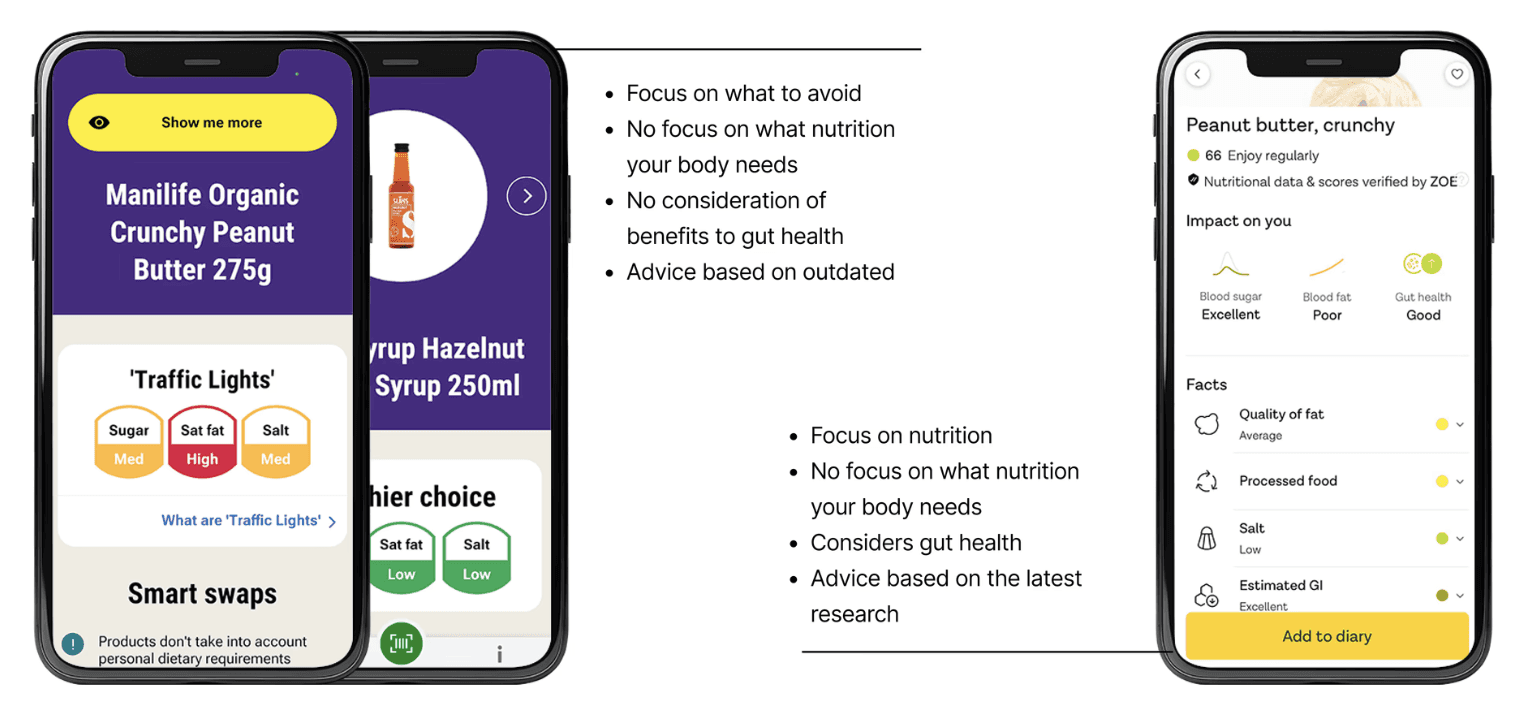
We repeated this across a range of everyday products and found the same divergence consistently. This wasn't a corner case. This confirms that ZOE's value proposition is not just personalisation, but a complete paradigm shift away from one-dimensional nutrition metrics (like fat/calories) toward a holistic view of food's impact on gut and metabolic health.
We repeated this across a range of everyday products and found the same divergence consistently. This wasn't a corner case. This confirms that ZOE's value proposition is not just personalisation, but a complete paradigm shift away from one-dimensional nutrition metrics (like fat/calories) toward a holistic view of food's impact on gut and metabolic health.
The traffic light system is a public infrastructure that reaches every consumer, regardless of income. ZOE's science is a privately held tool that reaches a small, affluent minority.
The opportunity is to ask what happens when personalised, evidence-based nutrition guidance meets the point of purchase.
The traffic light system is a public infrastructure that reaches every consumer, regardless of income.
ZOE's science is a privately held tool that reaches a small, affluent minority. The opportunity is to ask what happens when personalised, evidence-based nutrition guidance meets the point of purchase.
The traffic light system is a public infrastructure that reaches every consumer, regardless of income.
ZOE's science is a privately held tool that reaches a small, affluent minority. The opportunity is to ask what happens when personalised, evidence-based nutrition guidance meets the point of purchase.
What did I learn?
What did I learn?
REFLECTION
REFLECTION
REFLECTION
The research journey wasn't a linear process in this case.
The research journey wasn't a linear process in this case.
I started at the point: one user, one experience, one comment, another contrasting comment...
the path to the patterns and system wasn't straight, it looped back, shifted focus,
and opened into directions we hadn't planned for. Each iteration surfaced something the previous one had missed.
The only way through was to keep asking. Curiosity isn't a research method. It's a refusal to accept the surface answer.