2.5-month Academic project, Royal College of Art, 2024-2025
2.5-month Academic project, Royal College of Art, 2024-2025
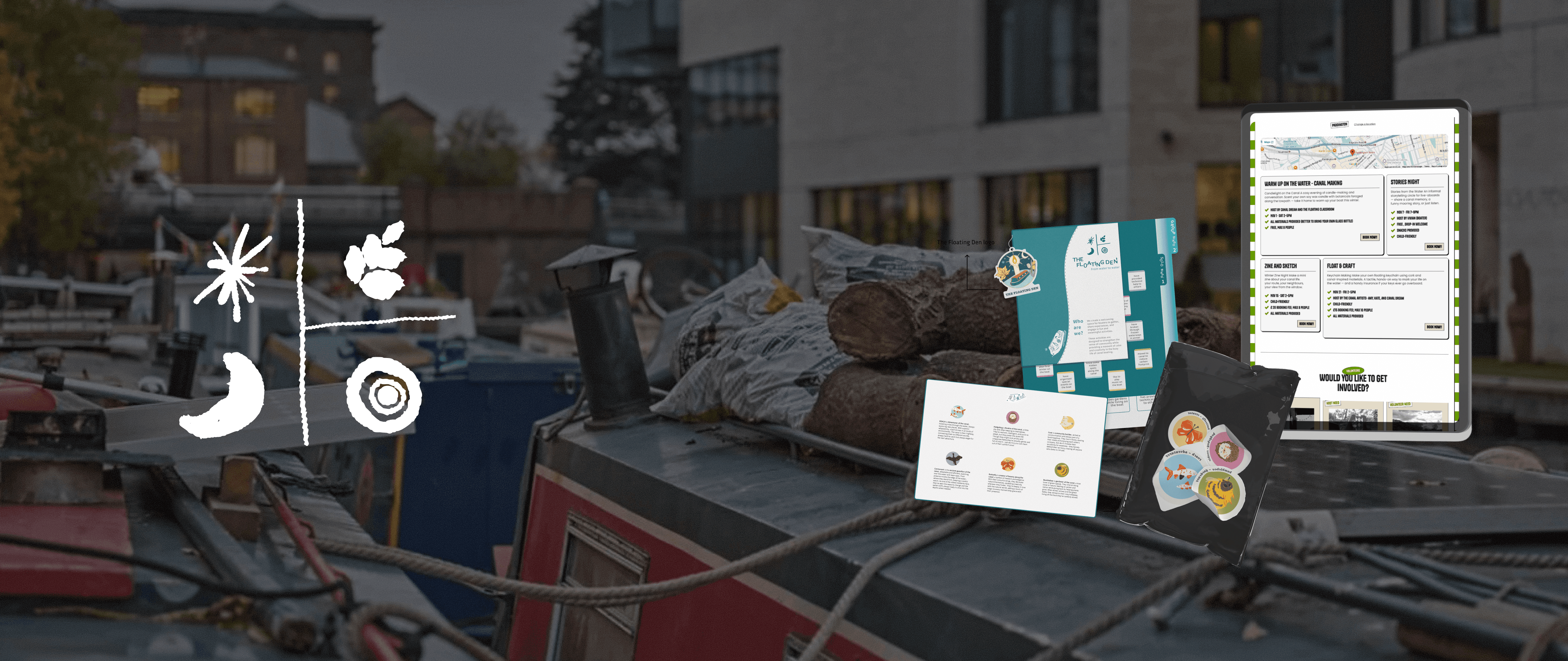
BUILDING AN END-TO-END SERVICE SYSTEM FOR STRENGTHENING THE CANAL LIVING COMMUNITY
BUILDING AN END-TO-END SERVICE SYSTEM FOR STRENGTHENING THE CANAL LIVING COMMUNITY
BUILDING AN END-TO-END SERVICE SYSTEM FOR STRENGTHENING THE CANAL LIVING COMMUNITY
This seasonal service system was partly adopted by 2 London NPOs to enhance 12% engagement and connectivity.
This seasonal service system was partly adopted by 2 London NPOs to enhance 12% engagement and connectivity.
This seasonal service system was partly adopted by 2 London NPOs to enhance 12% engagement and connectivity.
Industry
Industry
Industry
Social Innovation-Non Profits
Social Innovation-Non Profits
Social Innovation-Non Profits
My Role
My Role
My Role
Service Designer
User Researcher
Service Designer
User Researcher
Service Designer
User Researcher
Design With
Design With
Design With
Canal Dream CIC;
Global Generation;
The Floating Classroom
Canal Dream CIC; Global Generation;
The Floating Classroom
Canal Dream CIC;
Global Generation;
The Floating Classroom
The Overview
The Overview
The Overview
This case study is a participatory service design project designed at the Royal College of Art, which set out to understand how London canal live-aboard boaters experience community on the water, and what conditions, designed with 3 non-profit partners, would help it become more resilient over time.
This case study is a participatory service design project designed at the Royal College of Art, which set out to understand how London canal live-aboard boaters experience community on the water, and what conditions, designed with 3 non-profit partners, would help it become more resilient over time.
This case study is a participatory service design project designed at the Royal College of Art, which set out to understand how London canal live-aboard boaters experience community on the water, and what conditions, designed with 3 non-profit partners, would help it become more resilient over time.
Research Challenge
Research Challenge
Research Challenge
Water-based communities face a mix of physical, social and financial challenges, from having to move their boats every two weeks to dealing with seasonal depression and isolation. But the deeper challenge was relational: many boaters had been the subject of research before, without seeing any improvement in their lives. That history made them defensive.
The discovery process therefore ran on two parallel tracks: one working with partner organisations using service design methods, one working directly with boaters using approaches drawn from sociological situationism under the pressure of limited trust.
2-Side Research
Crossed Research Perspective (Sociological & Participatory)
Water-based communities face a mix of physical, social and financial challenges, from having to move their boats every two weeks to dealing with seasonal depression and isolation. But the deeper challenge was relational: many boaters had been the subject of research before, without seeing any improvement in their lives. That history made them defensive.
The discovery process therefore ran on two parallel tracks: one working with partner organisations using service design methods, one working directly with boaters using approaches drawn from sociological situationism under the pressure of limited trust.
2-Side Research
Crossed Research Perspective (Sociological & Participatory)
Water-based communities face a mix of physical, social and financial challenges, from having to move their boats every two weeks to dealing with seasonal depression and isolation. But the deeper challenge was relational: many boaters had been the subject of research before, without seeing any improvement in their lives. That history made them defensive.
The discovery process therefore ran on two parallel tracks: one working with partner organisations using service design methods, one working directly with boaters using approaches drawn from sociological situationism under the pressure of limited trust.
2-Side Research
Crossed Research Perspective (Sociological & Participatory)
Design Results
Design Results
Design Results
The Floating Den: a seasonal community platform
designed to work with the grain of boater life rather than against it.
Co-organised by the three partner organisations, and was adapted later by 2 partners and enhanced 12% engagement, the platform has two components:
an in-person workshop toolkit for facilitating events
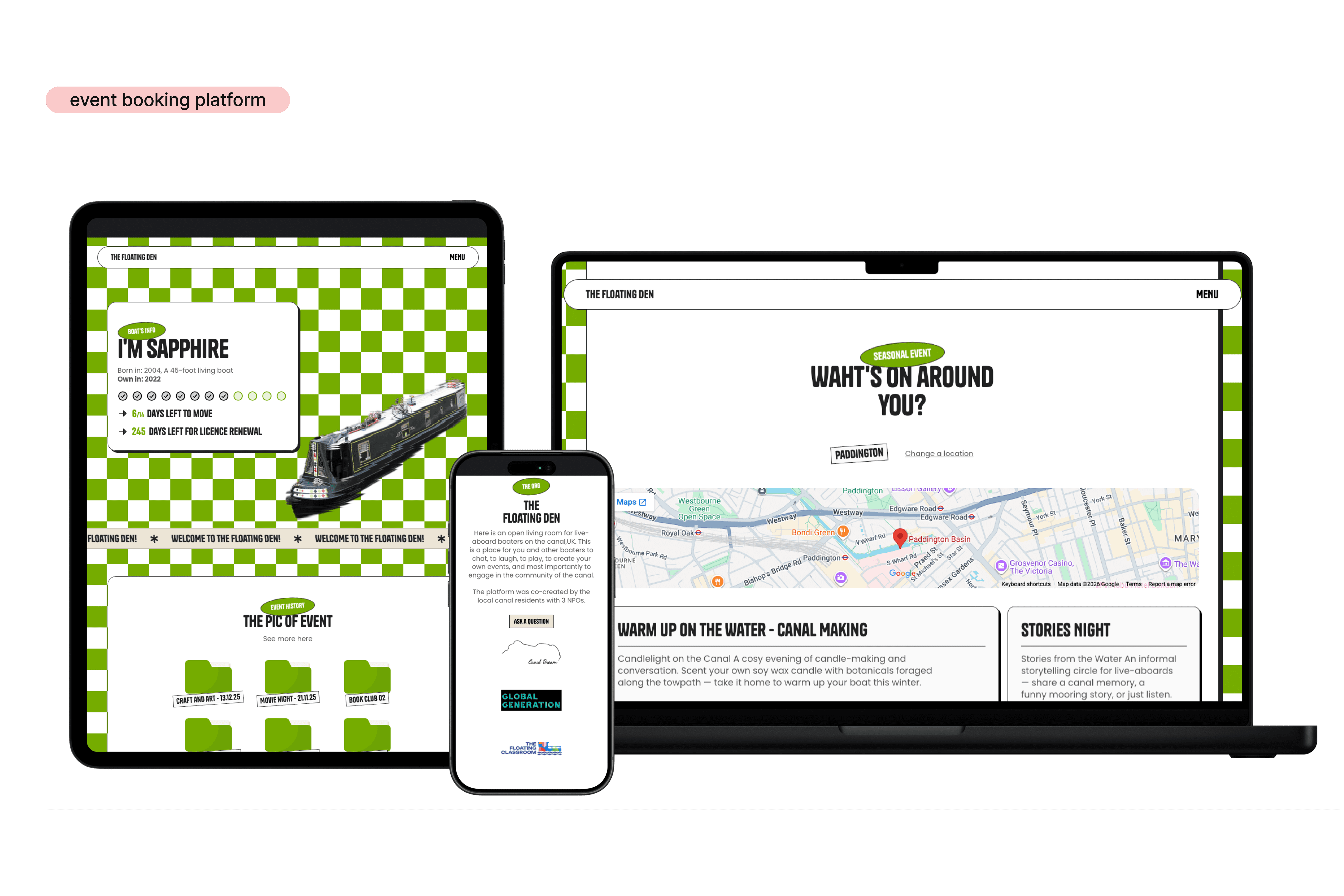
the boater-facing digital platform for event booking
A set of canal-based research principles and methods
including a combined template that integrates psychogeographic mapping with diary study, designed specifically for research with transient, place-attached users.
The Floating Den: a seasonal community platform
designed to work with the grain of boater life rather than against it.
Co-organised by the three partner organisations, and was adapted later by 2 partners and enhanced 12% engagement, the platform has two components:
an in-person workshop toolkit for facilitating events
the boater-facing digital platform for event booking
A set of canal-based research principles and methods
including a combined template that integrates psychogeographic mapping with diary study, designed specifically for research with transient, place-attached users.
The Floating Den: a seasonal community platform
designed to work with the grain of boater life rather than against it.
Co-organised by the three partner organisations, and was adapted later by 2 partners and enhanced 12% engagement, the platform has two components:
an in-person workshop toolkit for facilitating events
the boater-facing digital platform for event booking
A set of canal-based research principles and methods
including a combined template that integrates psychogeographic mapping with diary study, designed specifically for research with transient, place-attached users.
(click to see details)
(click to see details)

Where DID this began? What did i found?
Where DID this began? What did i found?
BACKGROUND & PROBLEM
BACKGROUND & PROBLEM
BACKGROUND & PROBLEM

The road of London canal resilience
The road of London canal resilience
The road of London canal resilience
London Canal was originally built as private waterways belonging to local industries during the Industrial Revolution.
Over time, as railways took over, canals became quieter, turning into natural habitats and playgrounds. The Canal & River Trust (CRT) now carries out the main management.
Nowadays, canals have taken on a new life. With more people choosing to live or work on narrowboats for various reasons, these waterways have become not just natural spaces but also vibrant communities. There are mainly two types of live-aboard boaters — Permanent Moorers and Continuous boaters(boats without home mooring). Continuous cruisers make up around one-fifth of licensed boaters nationally, approximately 36% of them are concentrated in London, a proportion that has nearly doubled since 2012, driven largely by the housing crisis.
London Canal was originally built as private waterways belonging to local industries during the Industrial Revolution.
Over time, as railways took over, canals became quieter, turning into natural habitats and playgrounds. The Canal & River Trust (CRT) now carries out the main management.
Nowadays, canals have taken on a new life. With more people choosing to live or work on narrowboats for various reasons, these waterways have become not just natural spaces but also vibrant communities. There are mainly two types of live-aboard boaters — Permanent Moorers and Continuous boaters(boats without home mooring). Continuous cruisers make up around one-fifth of licensed boaters nationally, approximately 36% of them are concentrated in London, a proportion that has nearly doubled since 2012, driven largely by the housing crisis.

5,000+
5,000+
Continuous Cruiser boaters in London
Continuous Cruiser boaters in London
*Data: Canal & River Trust (CRT) for late 2024
*Data: Canal & River Trust (CRT) for late 2024
5,000+
Continuous Cruiser boaters in London
*Data: Canal & River Trust (CRT) for late 2024


The challenges of boat life are both tangible and intangible
The challenges of boat life are both tangible and intangible
The challenges of boat life are both tangible and intangible
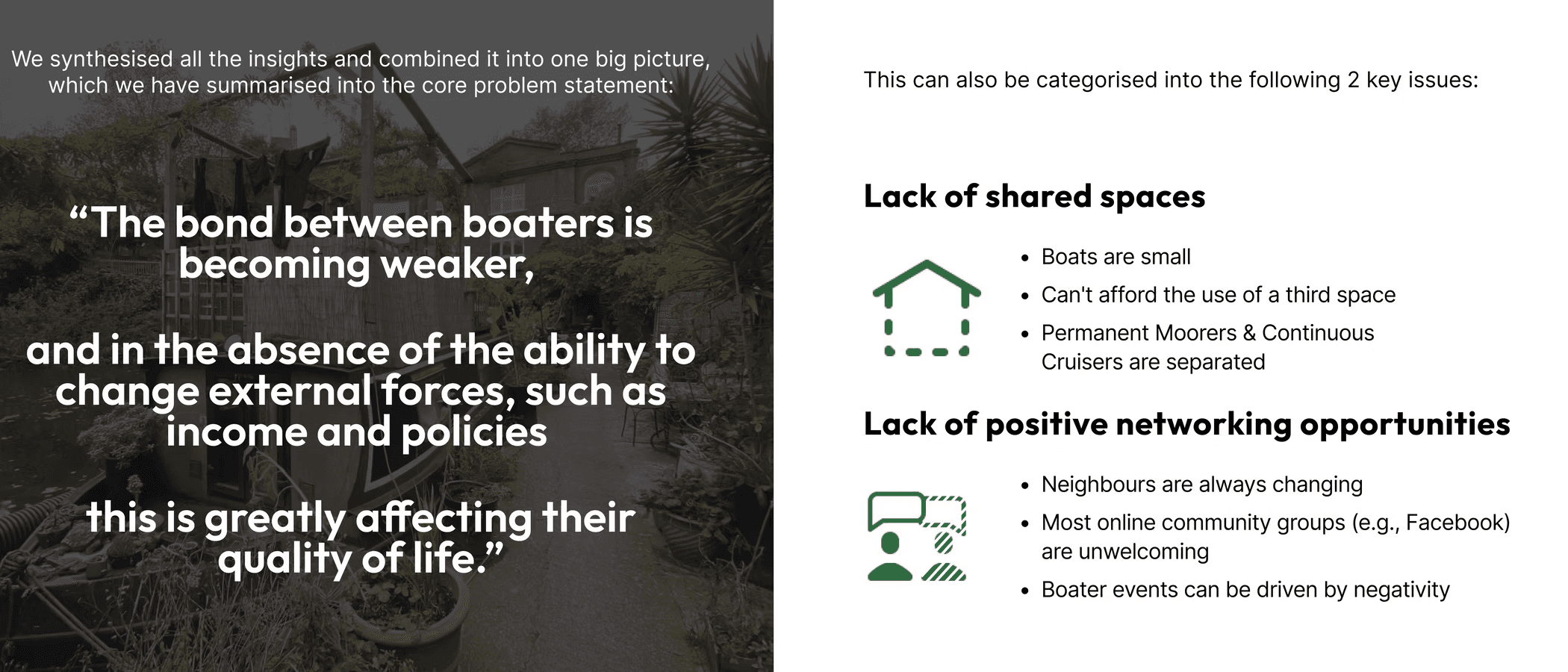


Pain point 01
Life on a canal boat is challenging: physically, emotionally, mentally
Pain point 01
Life on a canal boat is challenging: physically, emotionally, mentally
Pain point 02
Boaters’ bonds with each other are weakening, and they lack dedicated spaces to build these connections
How Might We
How Might We
How Might We
How might we empower live-aboard boaters, especially continuous boaters, to develop stronger connections with each other, resulting in a more resilient, independent and uplifting community?
How might we empower live-aboard boaters, especially continuous boaters, to develop stronger connections with each other, resulting in a more resilient, independent and uplifting community?
How might we empower live-aboard boaters, especially continuous boaters, to develop stronger connections with each other, resulting in a more resilient, independent and uplifting community?
What did i create?
What did i create?
DESIGN DELIVER
DESIGN DELIVER
DESIGN DELIVER
The Floating Den - Physical and digital community service
The Floating Den - Physical and digital community service
The Floating Den - Physical and digital community service
The Floating Den is a community platform co-run by canal-based NGOs and live-aboard boaters on London's waterways.
The number of London live-aboard boaters is growing but underserved, with limited access to formal social or community support structures. The platform exists to solve a simple but persistent problem: boaters who live metres apart from each other, but have no infrastructure to actually meet, not to mention the communications.

What it offers
Physical: A series of in-person seasonal events held canal-side, facilitated by staff, volunteers and boaters, alongside a set of icebreak tools for activities (including a game, stickers and instructions). Events are related to seasonal canal heritages, such as candle making, floating keychain crafting, storytelling circles, zine nights. The format was directly tested through 3 rounds of prototypes and usability tests, informed by research findings: structured enough to give strangers a reason to be in the same room, open enough to let genuine conversation happen.
Digital: A boater-facing website where residents can browse and book seasonal events organised by our partners (Canal Dream, Global Generation and The Floating Classroom), publish the activities they want to co-organise, track their narrowboat's CRT licence renewal and 14-day cruising requirement, and browse an archive of past community gatherings. The tracker addresses one of the most consistent practical stressors of continuous cruising life; the event calendar gives the community a shared, visible rhythm across the year.
Design Details
Design details
(click to pause scrolling)
(click to pause scrolling)


Prototype Journeys
Prototype Journeys

Prototype 1
Prototype 1
Prototype 1
Low-fidelity prototypes developed with designers and partners to clarify functionality
Low-fidelity prototypes developed with designers and partners to clarify functionality

Prototype 2
Prototype 2
Prototype 2
Pilot testing with strangers (15+) to evaluate product usability, communication effectiveness and iterative optimisation
Pilot testing with strangers (15+) to evaluate product usability, communication effectiveness and iterative optimisation

Prototype 3
Prototype 3
Prototype 3
Pressure-test with real boaters , gathering real-world feedback to refine the details
Pressure-test with real boaters , gathering real-world feedback to refine the details
What did I build? What did I learn?
What did I build? What did I learn?
PROCESS & CHALLENGES
PROCESS & CHALLENGES
PROCESS & CHALLENGES
Design with them, rather than design for them
Design with them, rather than design for them


Halfway through our research phase, a boater stopped us on the towpath. Not aggressively — almost gently. He said: "I hope this actually leads to something. Because we've had a lot of people come and ask questions before."
He was a community leader. When we met him, he was handing out leaflets with his group, because CRT had just announced a rent increase, raising living costs for continuous cruisers through the winter.
Live-aboard boaters have a long history of being marginalised and researched. Yet life on the water rarely changes as a result. What I came to understand as a designer is that the cycle of attention without outcome is its own form of harm. Meanwhile, I realised that this water community has its own resilience; our role was not to fix it, but to work alongside it, and help people make the most of what they already had.
I proposed to the team that we change course. We were asking people to trust us with their experiences before we had done anything to earn that trust. Under time pressure, we made two decisions.
Halfway through our research phase, a boater stopped us on the towpath. Not aggressively — almost gently. He said: "I hope this actually leads to something. Because we've had a lot of people come and ask questions before."
He was a community leader. When we met him, he was handing out leaflets with his group, because CRT had just announced a rent increase, raising living costs for continuous cruisers through the winter.
Live-aboard boaters have a long history of being marginalised and researched. Yet life on the water rarely changes as a result. What I came to understand as a designer is that the cycle of attention without outcome is its own form of harm. Meanwhile, I realised that this water community has its own resilience; our role was not to fix it, but to work alongside it, and help people make the most of what they already had.
I proposed to the team that we change course. We were asking people to trust us with their experiences before we had done anything to earn that trust. Under time pressure, we made two decisions.
2-side Research Journey
2-side Research Journey

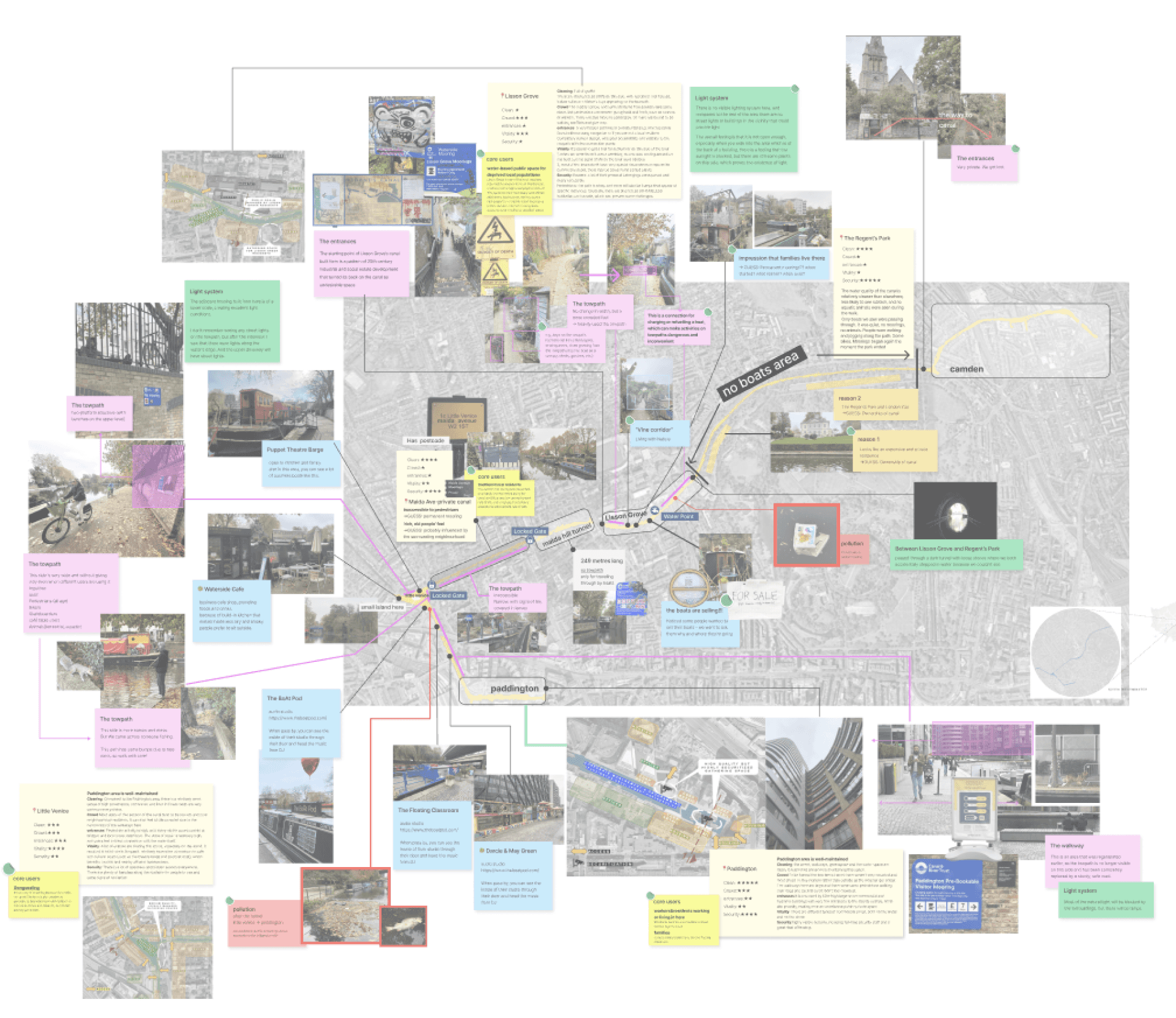
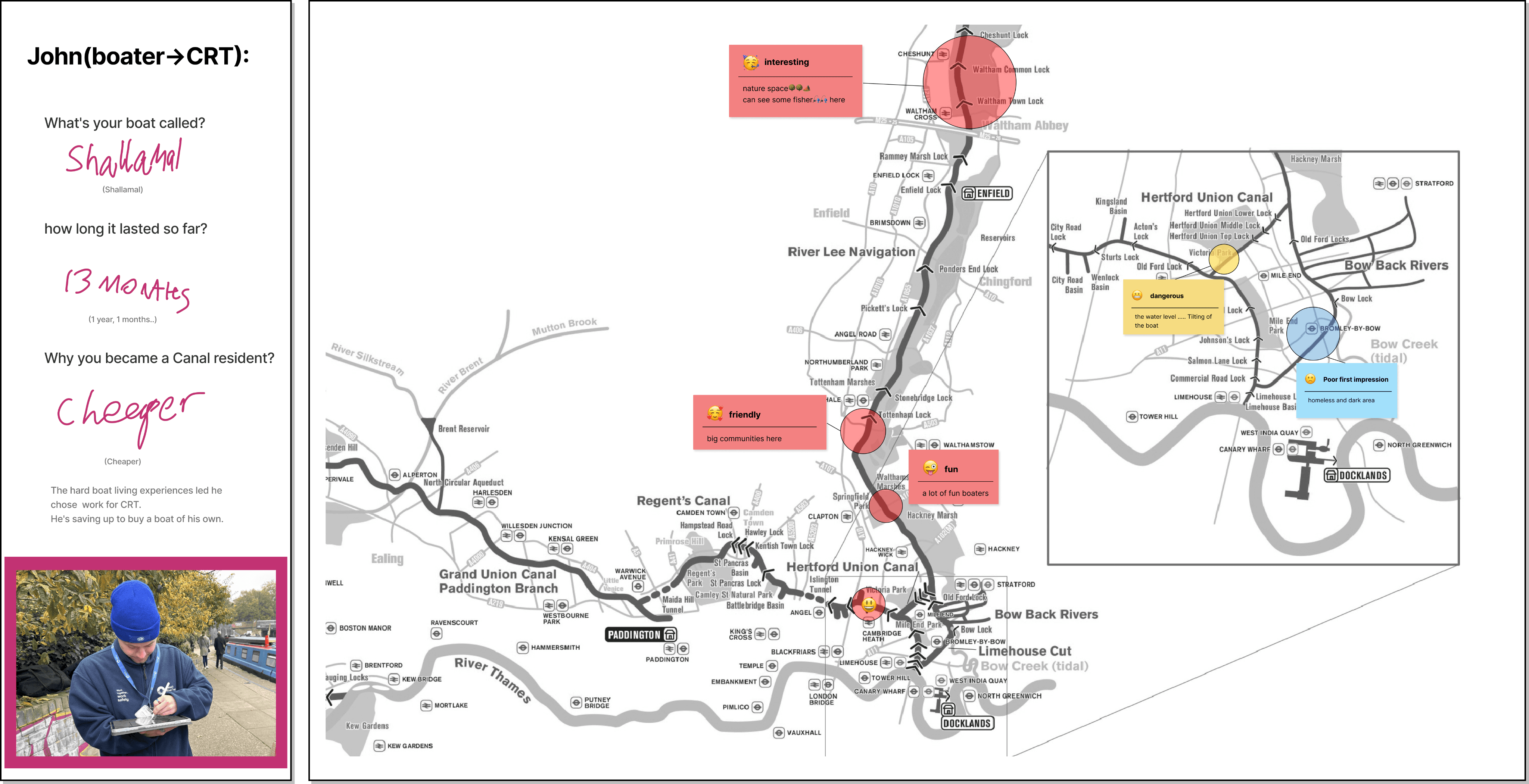
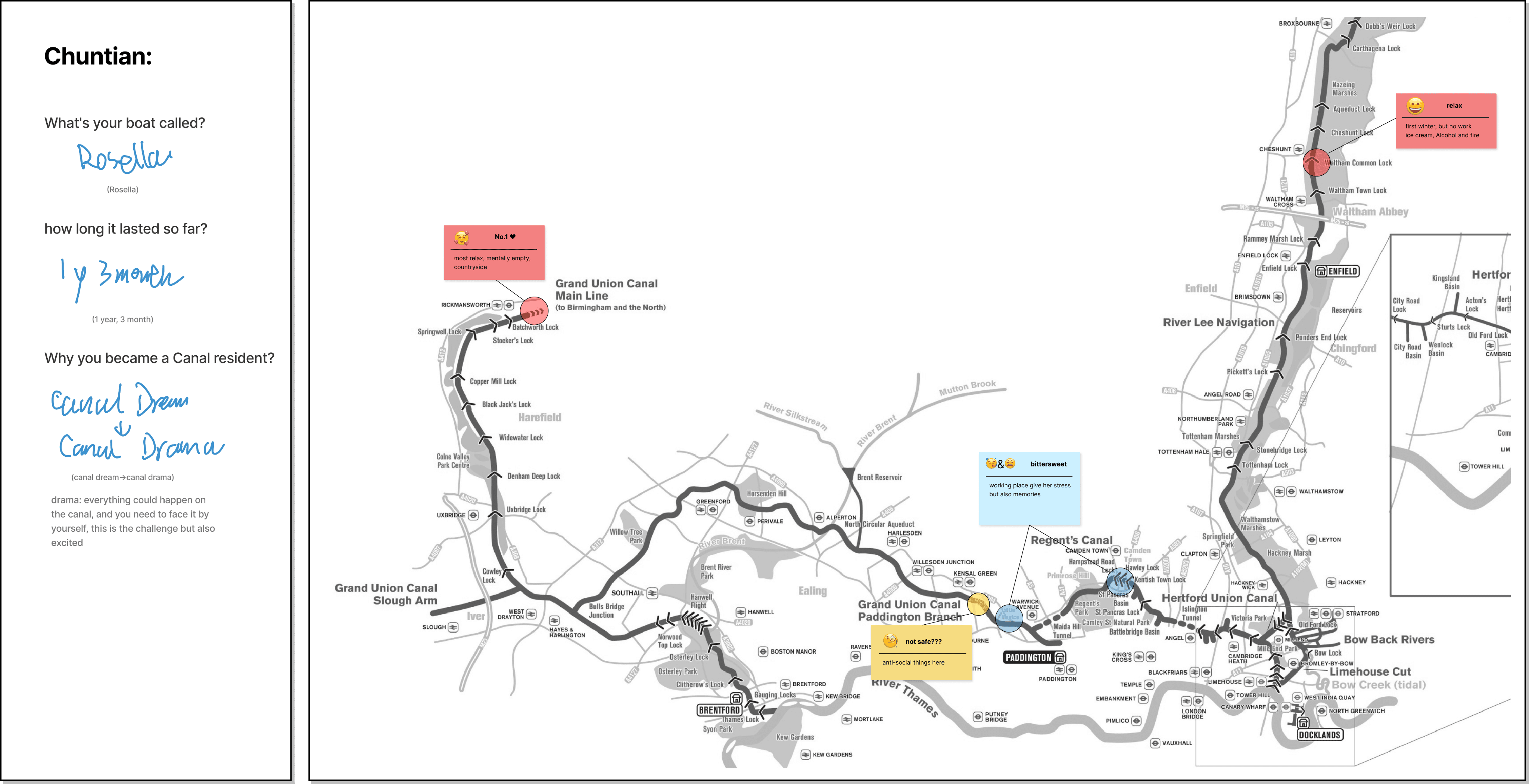
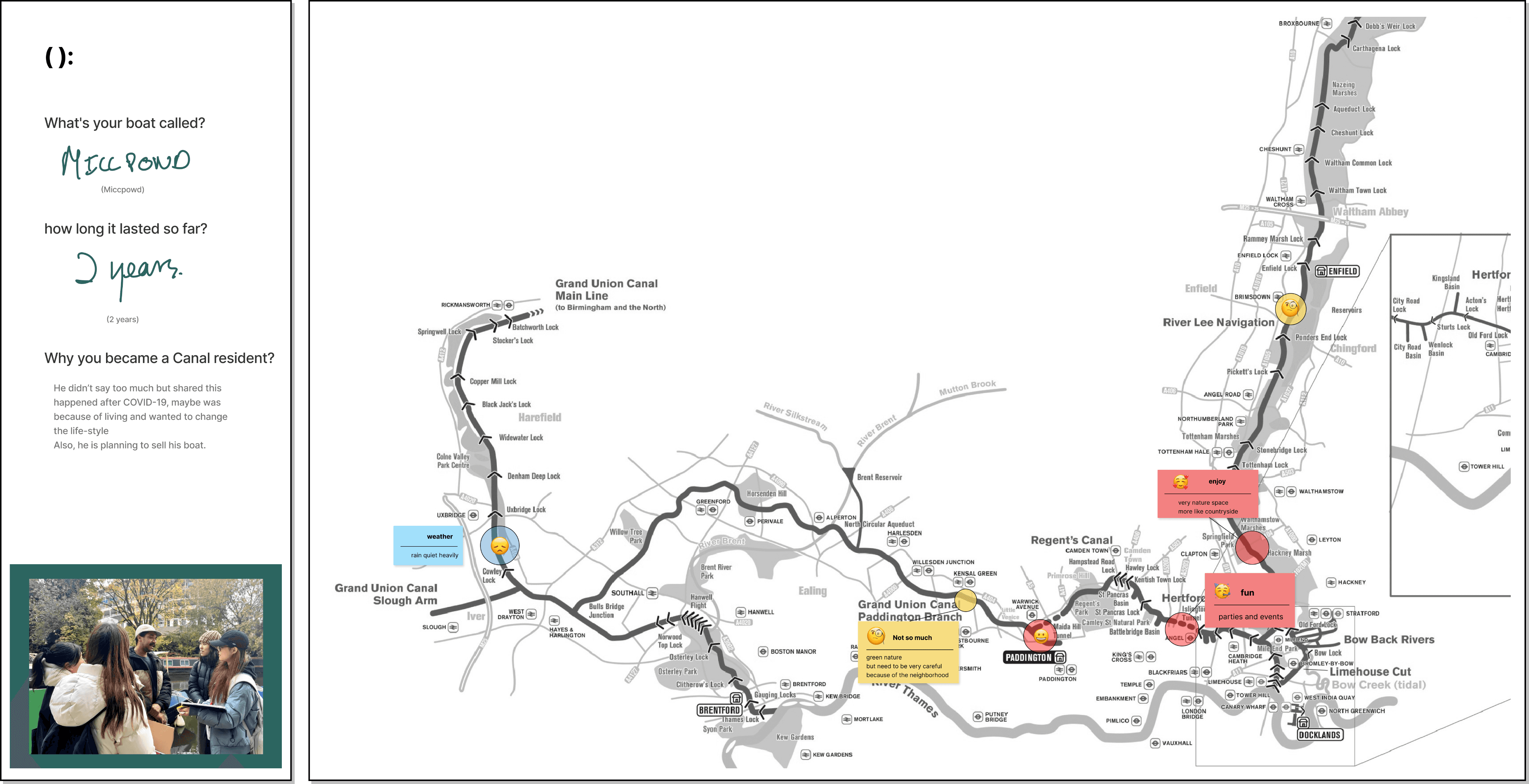
Example: psychopeopraphic map & diary study template
Example: psychopeopraphic map & diary study template
Example: psychopeopraphic map & diary study template


Research decision updates
Research decision updates
Research decision updates
Research split into two parallel research tracks
Track1 - systemic perspective: working with partner organisations through service design methods (including blueprint, value proposition, business model, etc) to understand organisational structures, resources, and ecosystem dynamics
Track2 - experience perspective: working with boaters through an approach drawn from sociological situationism: a psychogeographic mapping ↗︎ template that invited residents to document their own daily routes and emotional states across the waterway, rather than directly asking them about pain points and barriers through the interviews.
As the researchers, we changed how we showed up
We came in winter, in the cold, with hot water and some daily use, like tissue and firewood. We hoped to communicate something that words couldn't: that we were there in good faith.
we split into two parallel research tracks
Track1 - systemic perspective: working with partner organisations through service design methods (including blueprint, value proposition, business model, etc) to understand organisational structures, resources, and ecosystem dynamics
Track2 - experience perspective: working with boaters through an approach drawn from sociological situationism: a psychogeographic mapping ↗︎ template that invited residents to document their own daily routes and emotional states across the waterway, rather than directly asking them about pain points and barriers.
we changed how we showed up
We came in winter, in the cold, with hot water and some daily use, like tissue and firewood. We hoped to communicate something that words couldn't: that we were there in good faith.
Research split into two parallel research tracks
Track1 - systemic perspective: working with partner organisations through service design methods (including blueprint, value proposition, business model, etc) to understand organisational structures, resources, and ecosystem dynamics
Track2 - experience perspective: working with boaters through an approach drawn from sociological situationism: a psychogeographic mapping ↗︎ template that invited residents to document their own daily routes and emotional states across the waterway, rather than directly asking them about pain points and barriers through the interviews.
As the researchers, we changed how we showed up
We came in winter, in the cold, with hot water and some daily use, like tissue and firewood. We hoped to communicate something that words couldn't: that we were there in good faith.
reasons of similars
causes of conflicts
interesting locations
surprise findings
understand backgrounds
find opportunities
new perspectives
Hypothesis is just a starting point
Hypothesis is just a starting point
As designers, we arrive with assumptions. It is inevitable. But an untested hypothesis is just a guess dressed up as insight that carries real risk.
Boats moored inches apart, curtains drawn, no communication. We read that as disengagement between boaters at the beginning. After observation of boaters and interviews revealed it was something else entirely: unmet desire. Boaters wanted a connection. They just had no occasion for it to happen, and it is not easy to achieve under the real conditions.
That finding only became visible because we stayed close enough, went deeper enough, to see it and feel it by ourselves.
The role of research is not to confirm what we think we already know. It is to create the conditions for people to show us what we haven't yet imagined. The method we used from the beginning to the end is Co-creation, in this context, participatory design is a commitment to letting real connection, real contradiction, and real surprise shape the direction of the work.
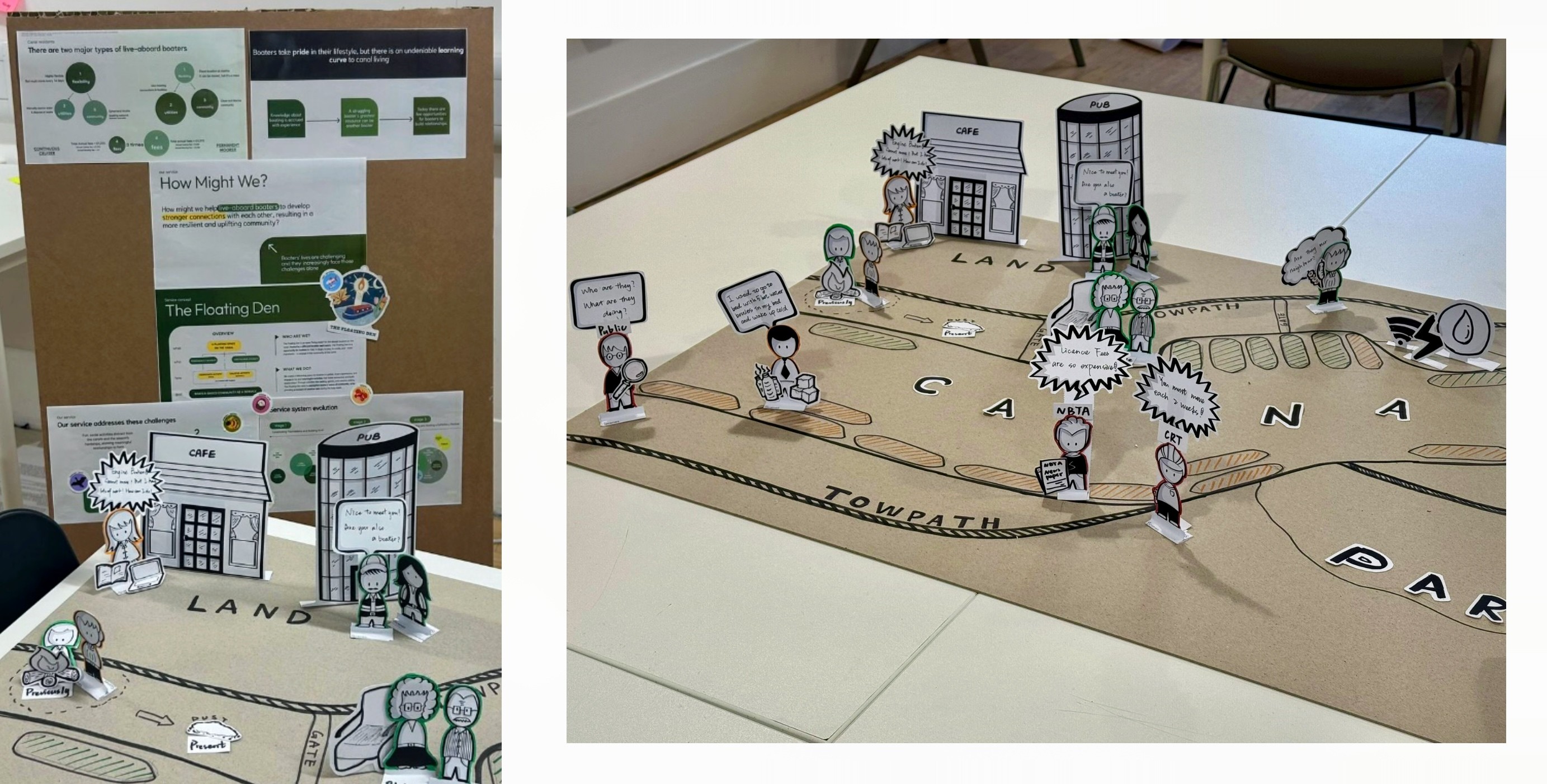
Without the real stories of boaters, there can be no authentic narratives of the canal, and it would be difficult to design outputs that truly mirror their experiences, needs and conflicts. In our final presentation to our partner, we also included this 3D storyboard based on the stories of over 30 boaters we had collected, from melting rivers, through flower-laden summer, to rivers frozen once again, allowing those of us living on land to gain a sense of their life.
As designers, we arrive with assumptions. It is inevitable. But an untested hypothesis is just a guess dressed up as insight that carries real risk.
Boats moored inches apart, curtains drawn, no communication. We read that as disengagement between boaters at the beginning. After observation of boaters and interviews revealed it was something else entirely: unmet desire. Boaters wanted a connection. They just had no occasion for it to happen, and it is not easy to achieve under the real conditions.
That finding only became visible because we stayed close enough, went deeper enough, to see it and feel it by ourselves.
The role of research is not to confirm what we think we already know. It is to create the conditions for people to show us what we haven't yet imagined. The method we used from the beginning to the end is Co-creation, in this context, participatory design is a commitment to letting real connection, real contradiction, and real surprise shape the direction of the work.
Without the real stories of boaters, there can be no authentic narratives of the canal, and it would be difficult to design outputs that truly mirror their experiences, needs and conflicts. In our final presentation to our partner, we also included this 3D storyboard based on the stories of over 30 boaters we had collected, from melting rivers, through flower-laden summer, to rivers frozen once again, allowing those of us living on land to gain a sense of their life.
What did I get?
What did I get?
EVALUATION
EVALUATION
EVALUATION
Evaluation 3
Broader impact
The psychogeographic diary template developed for this project has potential use beyond canal communities, anywhere that researchers need to work with transient or historically marginalised groups who are resistant to conventional research methods. The dual-track methodology is transferable.
Evaluation 4
Trade-offs and honest limits
The platform's digital component remains a concept and demo. Building and maintaining it requires ongoing technical resources and funding that the partner organisations do not currently have capacity for.

Evaluation 1
<- From prototype to practice
The seasonal event framework was subsequently adopted by Canal Dream CIC, who have since run a growing programme of canal-side community workshops that directly reflect the format and philosophy developed through this project. The model proved transferable: low-cost, craft-centred, place-rooted, and open.
Evaluation 1
From prototype to practice
The seasonal event framework was subsequently adopted by Canal Dream CIC, who have since run a growing programme of canal-side community workshops that directly reflect the format and philosophy developed through this project. The model proved transferable: low-cost, craft-centred, place-rooted, and open.
Evaluation 2
Feedback from pre-launch tests
87.5% of participants reported active engagement throughout the session. What actually happened in the room is that by the end of the session were exchanging invitations to private events( informal water bus cruises, personal gatherings) , the connection happened on its own terms. Participants also told us what they wanted next: more practical, boat-life-specific crafting — floating keychains were mentioned directly.
Evaluation 3
Broader impact
The psychogeographic diary template developed for this project has potential use beyond canal communities, anywhere that researchers need to work with transient or historically marginalised groups who are resistant to conventional research methods. The dual-track methodology is transferable.
Evaluation 4
Trade-offs and honest limits
The platform's digital component remains a concept and demo. Building and maintaining it requires ongoing technical resources and funding that the partner organisations do not currently have capacity for.
Evaluation 1
Life on a canal boat is challenging: physically, emotionally, mentally
The seasonal event framework was subsequently adopted by Canal Dream CIC, who have since run a growing programme of canal-side community workshops that directly reflect the format and philosophy developed through this project. The model proved transferable: low-cost, craft-centred, place-rooted, and open.
What did I learn?
What did I learn?
Reflection
Reflection
Reflection
The real impact lies not in what you launch, but in how many seeds you plant.
The real impact lies not in what you launch, but in how many seeds you plant.
The real impact lies not in what you launch, but in how many seeds you plant.
One of the most valuable lessons I’ve taken from this project is the shift in mindset from ‘designer as problem-solver’ to ‘designer as partner’. As a designer, I used to focus heavily on outcomes, such as tangible deliverables, touchpoints and impact. But through this project, I realised that the process itself holds just as much, if not more, value.
The way we interacted with users, by listening, co-creating and building trust, not as subjects but as equals—fundamentally shaped our work. We stepped into their world, experienced their lives and did our best to truly empathise. It is not about designing for them, but with them.
One of the most valuable lessons I’ve taken from this project is the shift in mindset from ‘designer as problem-solver’ to ‘designer as partner’. As a designer, I used to focus heavily on outcomes, such as tangible deliverables, touchpoints and impact. But through this project, I realised that the process itself holds just as much, if not more, value.
The way we interacted with users, by listening, co-creating and building trust, not as subjects but as equals—fundamentally shaped our work. We stepped into their world, experienced their lives and did our best to truly empathise. It is not about designing for them, but with them.
One of the most valuable lessons I’ve taken from this project is the shift in mindset from ‘designer as problem-solver’ to ‘designer as partner’. As a designer, I used to focus heavily on outcomes, such as tangible deliverables, touchpoints and impact. But through this project, I realised that the process itself holds just as much, if not more, value.
The way we interacted with users, by listening, co-creating and building trust, not as subjects but as equals—fundamentally shaped our work. We stepped into their world, experienced their lives and did our best to truly empathise. It is not about designing for them, but with them.
Special thanks to:
Special thanks to: